- Call: 07827 071812
- Email: info@lockguy.co.uk
In the locksmith world there are a whole load of technical terms used to describe a number of parts and situations. This article explains Locksmith terminology for some of the most commonly used terms.
So, if you have ever wondered what something means, or want to be able to describe something to a locksmith, or maybe you want to become a locksmith – then this article is for you.
In alphabetical order:
Bitting – The pattern of cuts or notches on a key that correspond to a specific lock.
Bolt – When referring to a lock, this is the normally rectangular shaped metal part that retracts and extends making it physically lock and unlock
Bow – The part of the key that you hold when you turn it in the lock
Cam – In the context of a lock, it is the arm/plate/bar that rotates when the key is turned
Camlock – These locks are usually found on mailboxes, cabinets and lockers. They are a simple lock with usually an arm on the back that rotates in and out of a catch when the key is turned.
Differs – This is means that a lock has its own unique key and that key cannot open any other locks. Often used in the phrase ‘keyed to differ’
Espagnolette – The locking device/gearbox normally found in uPVC windows.
Escutcheon – This protects and surrounds the keyhole or lock cylinder. It provides a nice finish and gives extra security preventing easy access to the lock.
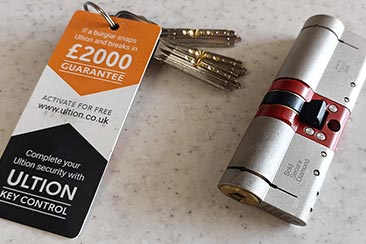
Euro cylinder* – This is a common type of door lock with a distinctive industry standard profile/shape. There are many manufacturers, types and levels of security.
Faceplate – This is the visible part of the lock or locking mechanism that you can see when it is installed. This will often have useful information to enable identification of the type of lock that you have.
Follower – This is the part of the locking mechanism that houses the spindle for the handle.
Friction stay – This is another term for the hinges on a uPVC window.
Gearbox – This is a generic term for the locking mechanism on a multi-point locking system usually found in uPVC and composite doors. The gearbox is the central part of the locking mechanism that houses the cylinder and connects to the locking points. It is positioned in between the handles. Read more here.
Jamb – This is part of the door frame. It is the vertical section that provides support for the door. On one side, it is where the hinges are positioned and on the other it provides a stop for the door preventing from opening in one direction.
Keep – These are fitted to the door frame and provide a secure housing for the multi-point locking points to fit into when being locked.
Keyed alike – This means that one key can operate more than one lock because all the locks that are keyed alike have the same bitting. See my Keyed Alike article for more information.
Keyway – This is the entrance to the lock. It is the specific part where the key is inserted.
Key safe – This is a small secure box that can be fitted somewhere on a property that is designed to house spare keys to enable access to people who have the necessary code to open it. There is more information on my article about key safes.
Latch – This is the part of the mechanism that is retracted when you pull down the handles of a door. When a door is closed, it is kept shut because the latch part is engaged within the door frame.
Lockout – This refers to a situation where someone is locked out of their property and needs to gain access.
Mortice lock* – This is the traditional style lock often referred to as a ‘Chubb’ style lock often found in wooden doors. The key has a metal rod with a bit at the end. It is operated via a system of internal levers. There are two types: sashlocks (with a latch) and deadlocks (without).
Nightlatch* – This is the locking mechanism typically fitted to the inside of a wooden door. It is connected to a rim cylinder. The latch on a nightlatch is retracted either with a key from the outside or a lever/knob from the inside.
Rebate – This is usually found on a set of double wooden doors. It refers to the recess cut into the edge of the door leaf or the door frame allowing the door to overlap to make it more secure and to create a tighter seal.
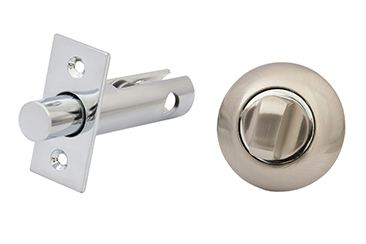
Rack bolt – This is a locking bolt that is fitted into a wooden door and can be operated with a hex style key or thumb turn. It is an additional security feature similar to a sliding bolt in that it can only be operated from the inside. It is stronger than a normal sliding bolt as it is fitted into the door, not on the surface.
Rim cylinder* – A traditional style lock that people often refer to as a ‘Yale’ lock. It is round in shape and is found on wooden doors. It connects to a nightlatch via a tailpiece.
Rim lock – This is fitted to the surface of a door. If is designed for thin wooden doors (e.g. a shed or a gate). They can have a latch and deadbolt, or just the deadbolt.
Rose – The circular plate that sits behind the handle or knob. The rose conceals any unsightly areas, e.g. fixing screws, rough wood edges, etc.
Sash jammer – This device consists of a body and an arm that can rotate to form an additional barrier to prevent doors and windows from being opened. They are operated only from the inside. Read more about sash jammers.
Shackle – The ‘hoop’ part of a padlock that clicks open when it is unlocked.
Shank – This is the long section of a key (normally referred to when describing a mortice lock key) between the bow and the bit at the end.
Shear line – When all the pins/levers in a lock are lined up to the correct position to enable the keyway to turn, then this is the shear line: the point at which a lock can be locked or unlocked.
Shootbolt – On a multi-point locking system, these are the locking points that travel in a vertical direction when the lock is engaged and disengaged. There is normally one at the top and at the bottom.
Snib – This is the name of the button on a nightlatch that is used to lock the latch in place (either in the retracted or extended position).
Spindle – The metal bar that connects with the handles and with the locking/latch mechanism.
Strike plate – Is the metal plate fitted to the door frame that works in conjunction with a spring-loaded latch. It allows the door to close freely, but will not allow it to open unless the handle is pressed down or the key is turned.
Thumb turn – The knob used to operate a euro cylinder from the inside of the door. I’ve written an article on thumb turn locks and fire regulations.
Wards – These are essentially obstructions in a lock that prevent the key from being inserted and/or turned. It refers to the shape/pattern on the profile of a key as locks only allow a specific shape to operate it.
Hopefully this Locksmith Terminology Buster and Glossary will be of some help as a reference document when searching for what you may need or how to describe a lock/key issue that you may be having.
If you have any questions related to this, or you need a locksmith in Essex, then feel free to get in contact.
*For more information on the types of household locks, please refer to: Types of Household Locks
Got a question about a lock issue you may have? Why not have a look at the FAQ page or one of the helpful advice videos on the Media page.