
We all know how important security is and locks are part of everyday life to protect us and out possessions. Locks have been in existence since modern civilisation was established. And humans have always sought to protect their valuables from other humans. My latest article looks at some of the history of locks.
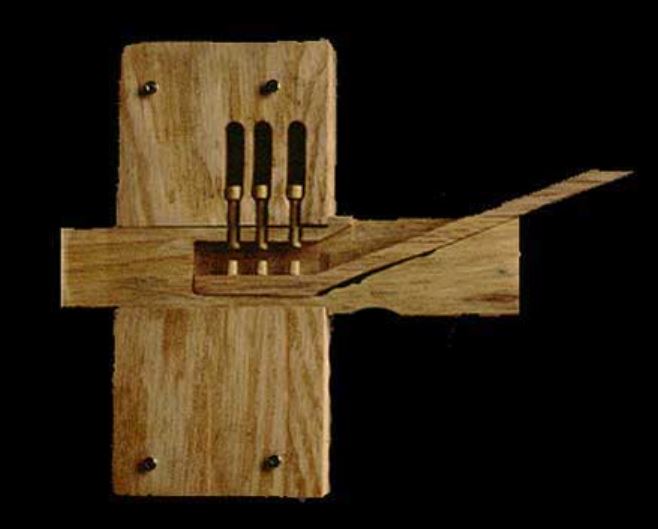
The history of mechanical locks started over 6 thousand years ago in Ancient Egypt. Here a simple but effective pin tumbler lock was created from wood. This lock had a horizontal bolt that slid into a wooden post that was attached to the door. The bolt had a series of openings containing pins. The ‘key’ was large and wooden and shaped like a toothbrush. It had pegs that corresponded to the holes and pins in the lock. This key would be inserted into the opening and lifted. This would move the pins and allow the security bolt to be moved.
(Pictured opposite).
The ancient Romans were the first to upgrade from wooden locks to metal ones between 870 and 900 BC. They developed metal locks and bronze keys that are familiar to us even today.
They took over the Egyptian model and made certain improvements. These were by adding wards, obstructions, and projections within the lock. These projections and obstructions were added to the lock in such a way that only a certain key could engage or disengage the lock. They were called “Warded Locks”!
The ancient Greeks also had their own separate lock developments around 700 BC with temple locks, or ‘Laconian locks’. Like the Romans, these locks consisted of a wooden bolt on guides on the inside of the door. Through a hole in the door, a person on the outside could slide the bolt back to open position using a very angular tool (key) made of bronze or iron. To lock it again, a thin rope or leather strap pulled the bolt into the staples in the door frame.
There were even Bible references in the Old Testament relating to locks and keys, including:
Isaiah 22:22: God gives Eliakim, the son of Hilkiah, the key of the house of David, which symbolizes the authority to admit or deny access to the king.
Judges 3:25: Refers to the key to the doors of King Eglon’s private quarters.
Subsequent to the fall of the Roman Empire in the 1st century, lock innovations halted. Now people did not have the technology or funds to create new protection techniques.
However, during this time new tactics were established to try to confuse those wanting to break into locks. Instead of one simple lock, other features were introduced such as multiple key mechanisms. They also made increasingly complicated key designs, hidden keyholes, fake keyholes, etc.
However, the real progress in lock evolution came in the 18th century. This is when technological advances finally enabled engineers to create small and sturdy mechanisms. These new locks were led by key inventors – of which many famous brands still use the inventors name today.
The notable inventions during this time were notably from Robert Barronin 1778 (double-acting tumbler lock), Joseph Bramah in 1784 (Bramah lock), Jeremiah Chubb in 1818 (detector lock with high internal security), Linus Yale, Sr. in 1848 (first pin tumbler lock), James Sargent in 1857 and 1873 (first combination lock and first time lock mechanism), Samuel Segal in 1916 (first jemmy-proof lock) and Harry Soref in 1924 (first padlock). The majority of the worlds locks that exist today are based on the inventions of these engineers.

Most locks existing today are based on these traditional designs. But there are further technological developments that have allowed for more advanced locking mechanisms. For example, magnetised locks that can operate via biometrics (e.g. a thumb print, voice activation or iris/eye scan). Or via an electronic signal (e.g. bluetooth connectivity). Smart locks are growing in popularity and are becoming more affordable. And the actual locking mechanism for many smart locks are still based on the traditional concepts.
One can only imagine the future of locks… perhaps with some kind of mind control activation. Or perhaps, there will be a future of no crime as depicted in certain science fiction novels (e.g. Minority Report’) – so maybe there will be no long-term need for a lock?
I hope this article on the History of Locks has been interesting. Or useful if you’re suffering from insomnia!
For further advice on anything lock related, or for any lock requirements in Essex, contact Lock Guy.
Got a question about a lock issue you may have? Why not have a look at the FAQ page or one of the helpful advice videos on the Media page.