
Due to global warming, we are seeing increasingly hot weather in the UK with prolonged spells of high temperatures. But can the heat affect your locks and their performance and, if it does, what can you do about it? This article, written by Lock Guy, a professional locksmith based in Essex, explains all about the impact of the hot weather on locks.
Put simply, hot weather will not impact the performance of your lock. Locks are based on proven technology that are designed to work in temperature extremes. All locks from any reasonably competent manufacturer should operate absolutely normally even in very hot temperatures.
In fact, as many locks are designed for use on fire doors, they are able to withstand the extreme heat of a fire (for normally 30 or 60 minutes).
(Read my article on fire door regulations for more information on this.)
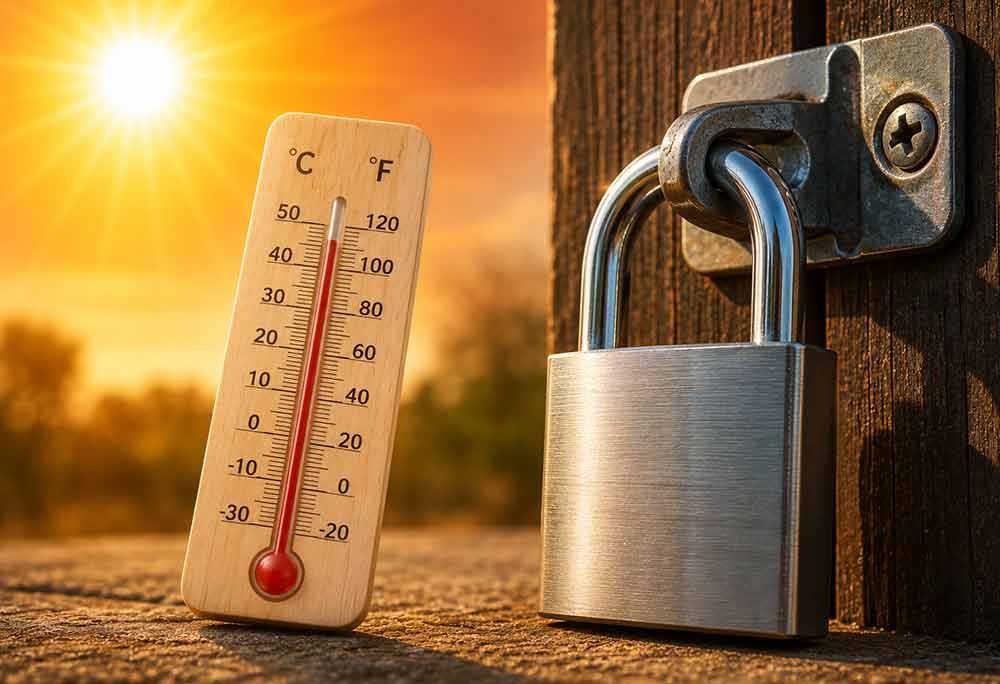
Domestic locksmiths do report having increased calls/workload in the Summer. This can be for a number of reasons, including:
· People put off problematic locks until the Summer when they want to be able to open, close, lock and unlock those doors and windows that have been a problem in the past.
· Residents are more active during nicer weather so that means there is more chance of someone getting locked out and of noticing problems with your lock.
· Many homeowners have more availability in the Summer (e.g. if they have more time off during school summer holidays) to get those problem lock related jobs sorted out.
· Whilst heat does not affect locks – it can affect other associated things.
For more information on this, read my article on seasonal lock problems.
So if locks are not affected by the hot weather, why do locksmiths receive additional calls when it is hot? The answer lies in the fact that metal expands in hot weather.
Metal expands because the added thermal energy causes the atoms to vibrate and push further away from each other.
This means that whilst the lock itself (the bit the key goes in) will be OK, there may be an issue with the locking mechanism (i.e. the bit that connects with the door frame and keeps the door locked).
If this expansion causes the locking points to not match up with the respective recesses in the door frame, then it can cause a clash and will not work.
Typically homeowners report that when they attempt to lift the handle on a multi-point mechanism, they are unable to lift the handles fully and therefore cannot turn the key. If the locking mechanism does not engage in the locked position fully – it will not lock.
Different metals expand at different rates, but the actual level of expansion of metal in hot weather is actually quite minimal.
Although the movement is often measured in fractions of a millimetre, it can be enough to affect the alignment between the door, frame and lock.
Engineering data shows that steel expands by around 12 micrometres per metre for every 1°C increase in temperature, while aluminium expands almost twice as much.
But doors and locking mechanisms are designed to allow for these slight movements in metal and allow enough tolerance for any expansion.
So, if the locks and locking mechanisms are designed to work in very hot conditions, why to people experience issues with their plastic and wooden doors? The answer lies in how the doors were fitted. As mentioned previously, there is a built-in tolerance to cope with these minor changes in metal size. But if the door was not fitted correctly (i.e. with enough tolerance), or if it has moved/dropped over time, then small fluctuations from heat can cause an issue.
Does the colour of the door have any effect?
Black and dark colours do absorb heat more than lighter colours – but there is still no reason for a black door to work fine in hot weather if it is fitted correctly.
There are realignment points on the hinges of doors to allow for adjustments to match if the locking points in the door with the respective mating parts in the frame. Or it might be possible to physically move the plate or keeps in the door frame into the correct position.
There are too many types of hinges on the market to offer direct guidance in this article, but if you are not sure, then contact an experienced and reputable locksmith as they will know exactly how to correct doors that are misaligned.
Some online advice advocates for cooling the problematic door by pouring/hosing cold water on to it. But this is a bad idea as excessive water can get trapped and cause corrosion. In any case, it will not solve the issue for next time it gets hot.
Can the heat affect your locks? The short answer is your locks and locking mechanisms can manage extreme spells of hot weather without issue. But the door itself may not have been fitted well or may have moved over time and may need realigning to resolve the problem.
If you have a new door, do not accept excuses from the installer about hot weather – that has nothing to do with it – it is just a badly fitted door.
If you want any further information or have an issue with a door not locking properly in Essex, then contact Lock Guy.
Got a question about a lock issue you may have? Why not have a look at the FAQ page or one of the helpful advice videos on the Media page.