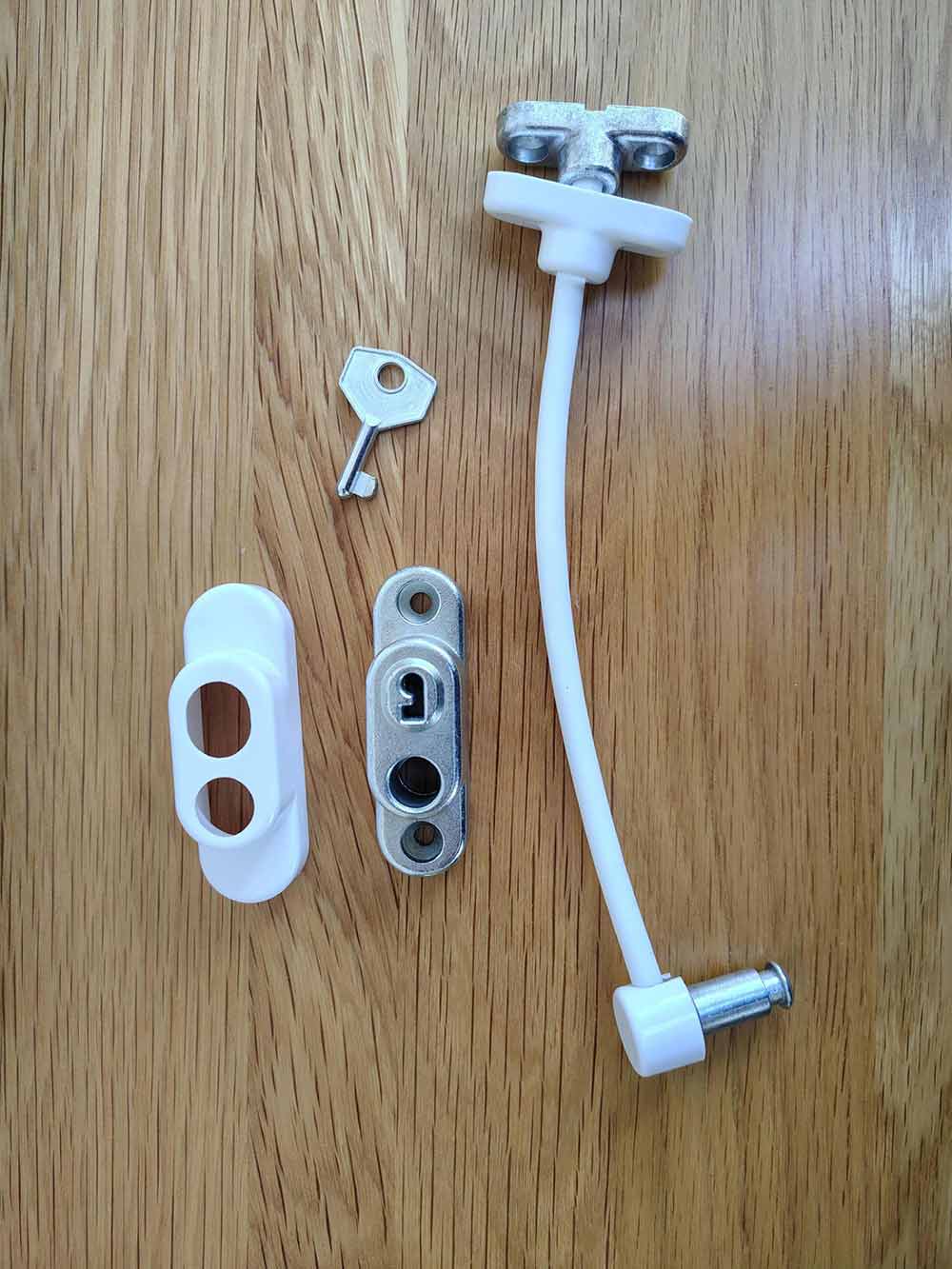
You may have noticed these window restrictor devices being fitted on windows on higher floors in places like offices, flats, hotels, care homes, hospitals and schools. Or you might be considering fitting them to a window in your home. But what are these products, when should they be used, what fitting requirements are there and which type is best? This article is all about window restrictors and discusses the use of window restrictors on domestic and commercial properties and is written by Lock Guy, a professional locksmith based in Essex.
What is a Window Restrictor?
Put simply, this is a safety product that attaches to a window to prevent it from being opened fully. They allow enough of a gap for ventilation purposes, but not wide enough for a person to fit through.
Without a window restrictor a person would be able to climb out of the window and potentially fall from a height which of course is extremely dangerous.
Companies often have window restrictors fitted on their premises to protect the occupants from potential injuries and to protect the business from liability.
In the home, they are used for the protection of young children who may be mischievous and might be able to open a window by themselves when they are not being supervised.
Types of Window Restrictor
Concealed: These types of window restrictors are not visible when the window is closed. There is a catch that is engaged when the window is opened. This can normally be detached by manoeuvring the catch to a specific position – but are considered safe for young children as the catch is difficult to open for youngsters.
Cable: Here there is a strong cable that is fixed in between the opening window and the window frame. The length of the cable and the fitting mean that it can physically open only so far. These are visible when the window is closed.
Locking: Typically, window restrictors have lockable versions meaning that they are supplied with a key and they can be unlocked and detached to allow the window to be fully opened.
Restrictor Stay: This is a physical metal arm that connects to the window to prevent it from opening fully
Friction restrictors: These are common on casement style windows and are built into the hinges to provide resistance and restrict the opening angle.
Concealed window restrictor
Cable window restrictor
Requirements
Building regulations for commercial properties do not necessarily require restrictors on all windows. However, risk assessments should be carried out to assess factors such as height, risk of falls, type of building, type of occupants, etc.
Where a window serves as an emergency escape route, the restrictor must not prevent emergency egress. A restrictor can still be fitted to an escape route, but it must allow full opening by a release mechanism (not using a key).
Homeowners should decide for themselves whether window restrictors are a good idea or not.
Fitting Requirements
The EN 13126-5:2011 + A1:2014 standard covers the strength, safety, and performance requirements for hardware devices that restrict the opening of windows.
To comply with the EN 13126-5:2011 + A1:2014 test standard, window restrictors need to be fitted so that the total opening of the whole length of the window is less than 89mm when used as a Child Safety Product and less than 100mm for all other requirements.
Some windows may require more than one restrictor to achieve compliance with the standard.
Standard window restrictors must withstand a continuous push force of 350 Newtons (N), equivalent to roughly 35 kg of weight force (held for 60 seconds)
Other Considerations
If you want to be able to use a window as an emergency exit (for example in the event of a fire) then do not opt for one that locks with a key.
The cost of cable restrictors are relatively cheap and if you are responsible for building safety or are a concerned parent, then they are often a necessary and sensible choice.
They can be retrofitted quite easily to all types of windows.
It is always a good idea to select a British Standards approved product to ensure it has been tested to the relevant quality standard.
A good locksmith will be able to provide the service of fitting window restrictors.
If you have any questions about window restrictors, want any further information or have requirements to fit window restrictors in Essex, then contact Lock Guy.